Friday, February 23, 2018

Servants of Death

Been thinking about school shootings and lockdown procedures in the wake of the Parkland massacre. I think about disaster/crisis scenarios a lot; the habit started after I saw Night of the Living Dead for the first time and ever since I have gauged how zombie-proof every building I've ever been in is. Aside from zombie apocalypse, I also try to plan what to do for real-world problems; I work part-time as a substitute teacher, so I've war-gamed active shooter situations in my head. In every classroom I think about what I need to do to secure it, where I need to be, where the students need to be. What I need to do, or try to do, in case a shooter breaches the room. I've never been in such a situation, obviously, I have no idea if any of the plans I've come up with would actually work. Nor do I know if in the event I would have the courage to do anything at all.

Here's the thing – I shouldn't have to entertain these thoughts. No teacher, no student, should have to entertain these thoughts. But there's an absolutely rabid obsession over guns and the supposed sanctity of the 2nd Amendment in this country. There's a segment of the population that values gun ownership over lives. The 2nd Amendment may have made sense when we were a young nation without a professional army, but times have changed, in ways the Founders couldn't possibly have imagined. Because of guns, we have far higher rates of murder and suicide per capita than any other first-world nation, and because of guns we live in terror of ourselves. We need to stop valuing guns more than children, we need to stop valuing death more than life, because make no mistake – those who value guns over people are the servants of death.

Saturday, December 16, 2017

"Sacrifices" - Short Story Now Available


A short read (about 2300 words), available for free if you're a subscriber to Kindle Unlimited, otherwise it's .99¢ - cheap!

From the Amazon description: "The Bible tells us that after Adam and Eve were expelled from the Garden of Eden, they had two sons, Cain and Abel, and that Cain killed his brother out of jealousy. But what if the first murder was committed for another reason? "Sacrifices" offers an alternate look at the first family, one that suggests a very different motive for Cain's act.

If you've ever read Genesis and asked yourself "why?" then this story is for you."


The story was inspired when I was rereading Genesis (as one does), and came across a couple of details that don't match up about who gets to eat what at the beginning of time, as I have written about previously. That got me to thinking about the whole Cain/Abel story and seeking an alternate explanation for why Cain kills his brother. This also gave me the opportunity to rethink Adam and Eve's relationship and present it in (I hope) a more sympathetic light.

Saturday, November 4, 2017

Why Do Fish - Fall From The Sky - Every Time - You Walk By?

I'm wondering what to make of all the accounts of "damned things" Charles Fort collected during his lifetime. ("Damned" because the scientific establishment in his day either completely ignored these events, or denied the validity of the reports.) Mostly I'm wondering why we don't hear of such things anymore. As far as I know, there's no cell phone footage of falls of fish or frogs, nor pictures of thousands of yellow and black worms upon a glacier.

(Such weird details in Fort's data, like he found multiple accounts of rains of frogs over the centuries, but never tadpoles. And lots of reports of worms on glaciers, or found after heavy snow.)

A cursory look at Youtube doesn't reveal any videos of these things actually falling from the sky, and the scientific establishment still says when it happens, it's due to waterspouts (which still doesn't answer Fort's question: why are the falls of animals always of a single species? Are the waterspouts discriminating in what they lift up?)

Fort had some odd suggestions as to why these sorts of things happened, including the possibility of "super-constructions" that periodically pass over the earth's surface and drop things. Also, that there's an area of null gravity some miles above the earth's surface, in which there are floating fields of ice and gelatin. (I do wonder how much he believed any of his own proposals; my impression is he didn't, really, but he didn't accept the received wisdom of the scientific establishment either.)

In any case, this sort of thing doesn't appear to happen much, if at all, any more. I think I know why.

Suppose the world as we know it is actually a simulation, one that has been running for a very long time. Perhaps all the unusual data Fort collected, all the "damned things" that could not be reconciled with scientific laws and known natural phenomena, were simply glitches in the simulation.

Why don't these "glitches" happen anymore? Whoever - or whatever* - is running the simulation has upgraded the system, replaced their hardware or software or both.


* Fort also wrote, "I think we're property."

Wednesday, October 25, 2017

Testament of Judas now $0 for a limited time only!

"What's that?" you say. "Zero dollars, as in free?"

Yes, indeed, totally free copies of the ebook available right now!

"What's the catch?"

Not much of one, my friend. Just go to bookgobbler.com right now, and you can get one of 13 copies of The Testament of Judas, with the understanding that if you do download a free copy, you will in return post a review once you've read it.

That's it! Easy-peasy!

But! Once the thirteenth copy is gone, that's it. If you've been on the fence about reading this book, don't pass up this opportunity.

Monday, October 16, 2017

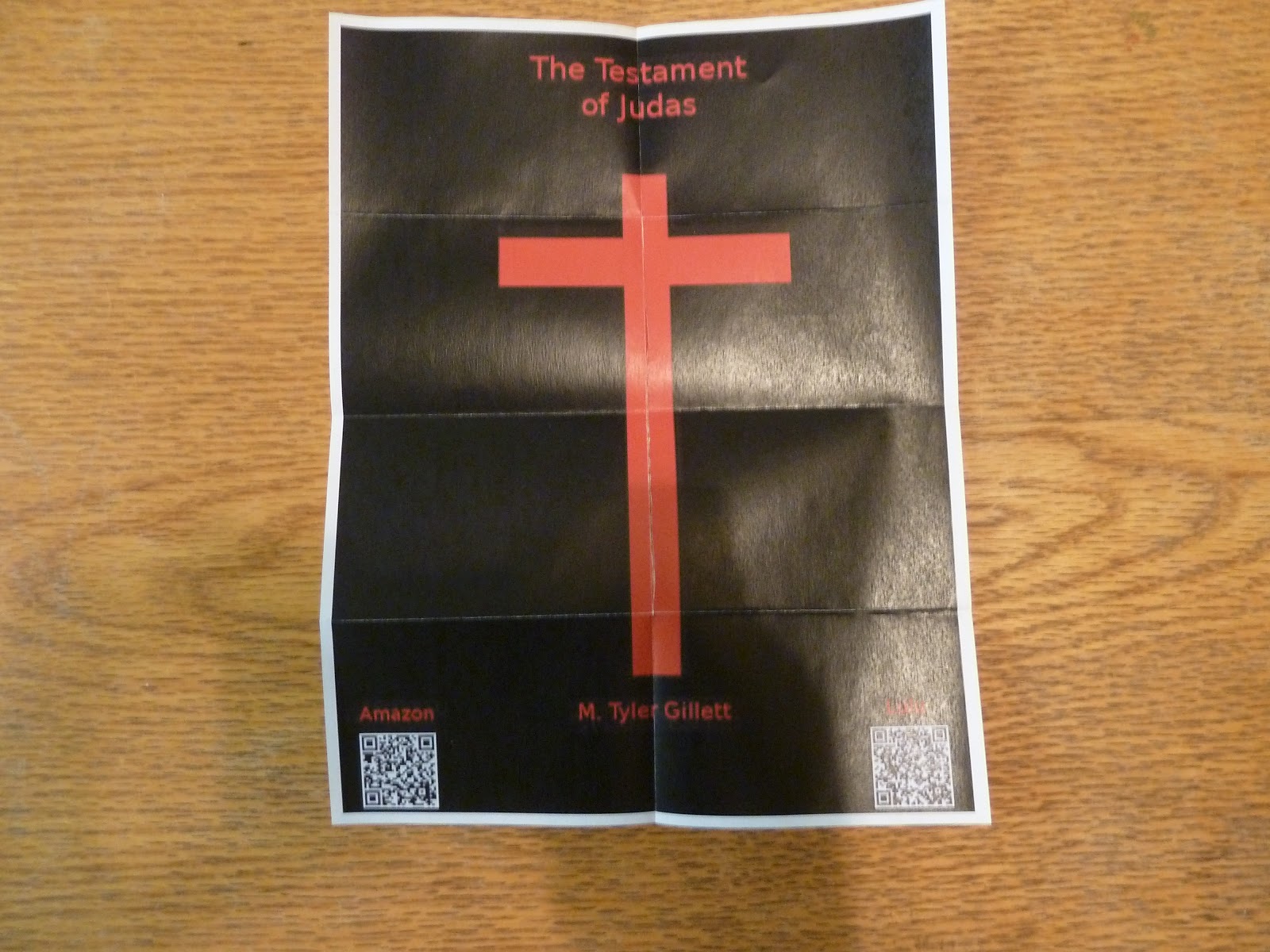
Evangelizing the Old-Fashioned Way

Ever want to get the word out about The Testament of Judas, but just aren't sure how to go about it?

How about passing out tracts to random strangers on the street? It works for regular Christians, right?

We here at ICoEDNUF have worked up an old-school one-page tract that is free for downloading. Print out a stack of 'em and go to town! Feel free to leave them in gas station restrooms, 24-hour laundromats, and wherever you find flimsy evangelical literature!


Sunday, October 15, 2017

Testament of Judas sale!

Saturday, August 5, 2017

Gods and Men

So, the story of Daphne and Apollo. The problem begins when Apollo, embodiment of all things masculine, makes fun of Eros' ability as an archer. As revenge, Eros shoots Apollo with an arrow that causes uncontrollable love.1 Meanwhile, Eros shoots Daphne, daughter of the river-deity Peneus, with an arrow that kills any and all romantic attraction or feeling. She just wants to be left alone in the forest – don't we all? Why Daphne, though? Why does she – or anyone else at all – have to be involved in Eros' plot against Apollo?

Not taking no for an answer, Apollo chases after Daphne, making this one of the earliest stories in the West illustrating patriarchal denial of women's sexual consent. They run through the forest until Daphne tires and cries out to her father to save her, specifically, to take away her beauty which, she thinks, is what provoked Apollo's lust. Peneus hears her and transforms her into a laurel tree. But because Apollo's insatiable desire has nothing to do with Daphne's appearance – really has nothing to do with her at all, save that she's a woman – he still seizes her, wrapping his arms around the tree trunk. Ovid informs us that Apollo can feel Daphne's beating heart underneath the bark, so not only is she still sensible and aware, as a tree she is firmly rooted to the ground and can no longer get away from her rapist. The story ends as Apollo claims the laurel tree for his own and fashions laurel wreaths as his own personal symbol.

Three male gods, all demonstrating a complete lack of regard for the lone woman in their midst. Eros uses Daphne as part of his scheme to humiliate Apollo, with no thought for Daphne's well-being. Also, it is not entirely clear how this whole plot resulted in Apollo's humiliation. Apollo personifies entitled male privilege that sees women only as possessions to be seized and used however he wants. Peneus, who had been lamenting his daughter's unwillingness to provide him with either a son-in-law or grandchildren, in the act of “aiding” her instead actually removes his daughter's agency and essentially throws her into the arms of her rapist.

Gods, it seems, in particular male gods, are reprehensible. Others have examined this before, of course, the patriarchal privilege and oppression of women found throughout the Greek mythic corpus, but it was not just the Greeks. Similar tales can be found in the Rig Veda, for instance. These myths did not cause misogyny so much as grant excuses for it, provide justifications for it, normalize it as part of the natural ways of the world. Interestingly, though, the Greeks themselves were uncomfortable with their own mythology. They eventually came to view their own gods as sociopathic. They knew the gods, as depicted by Homer, Hesiod, and the other poets, were vile, loathsome beings. However, these accounts by the poets, Homer and Hesiod especially, were myths, that is, scripture, so they could not simply abandon these tales. Their effort to rehabilitate the gods involved reading the old stories in a new light, reading them not as literal-if-mythic events but as allegories about the human condition and our place in the cosmos.

But does allegory actually provide a solution to the problem these myths raise? Allegorical reading, pleading that the story is actually saying something other than what it in fact is saying, is simply a poor attempt at having one's cake and eating it, too. If there were a lesson to be learned, a point to be made, an observation about humanity, the cosmos, and the divine, why not simply say it rather than couch it in an offensive and disturbing narrative? Another problem with insisting on an allegorical mode of interpretation is that it is all-too-easy for a reader to come to the wrong conclusions about the meaning of a text, because many different plausible arguments can be made about what the figures and events in a myth are meant to represent.

But theologically speaking, the greatest problem with allegorical approaches is they transform sacred texts into some sort of puzzle for the faithful, which makes of the gods a mystery. The gods themselves become unknowable, their motives unreadable, our relationship to them untenable. Any uncertainty in the compact between mortals and gods is dangerous, because any mistake on our part is easily fatal, or worse. For those who reflect on the consequences of allegorical interpretation, faith must become a minefield.


1 But is it really love? Or is this not the mythic beginning of the patriarchal – and misogynist – belief that men cannot control themselves sexually?